Pickleball is probably the fastest-growing sport in Taiwan right now. It blends tennis, badminton and table tennis: you hit a hollow, perforated plastic ball with a solid paddle, on a court exactly the size of a badminton doubles court. The ball is slower than tennis, the paddle is easier to control than a badminton racket, and you barely have to run — which is why it is widely considered the easiest racket sport to pick up. Most people rally for real within ten minutes of holding a paddle for the first time.
This guide covers the three things beginners actually get stuck on: how the rules work, where to play around Taipei, and what to do if you don't have anyone to play with.
What Is Pickleball, and Why Did It Blow Up?
Pickleball was invented in 1965 on Bainbridge Island near Seattle, and was named after the inventor's dog. It was designed from the start so the whole family could play together, which is why the ball is deliberately slow and the court deliberately small.
Its popularity isn't hard to explain:
- Almost no barrier to entry. Most racket sports require you to "get good" before they're fun. In pickleball you start playing as soon as the rules are explained.
- Easy on the body. A small court and limited movement mean far less load on knees and shoulders than tennis or badminton.
- Deeply social. It's played mostly as doubles, so two people constantly cover for each other and call shots — conversation happens on its own.
In Taiwan it took off in the second half of 2025, with sports centres, community colleges and corporate clubs adding sessions, and parks starting to mark out outdoor courts.
The Three Rules That Actually Matter
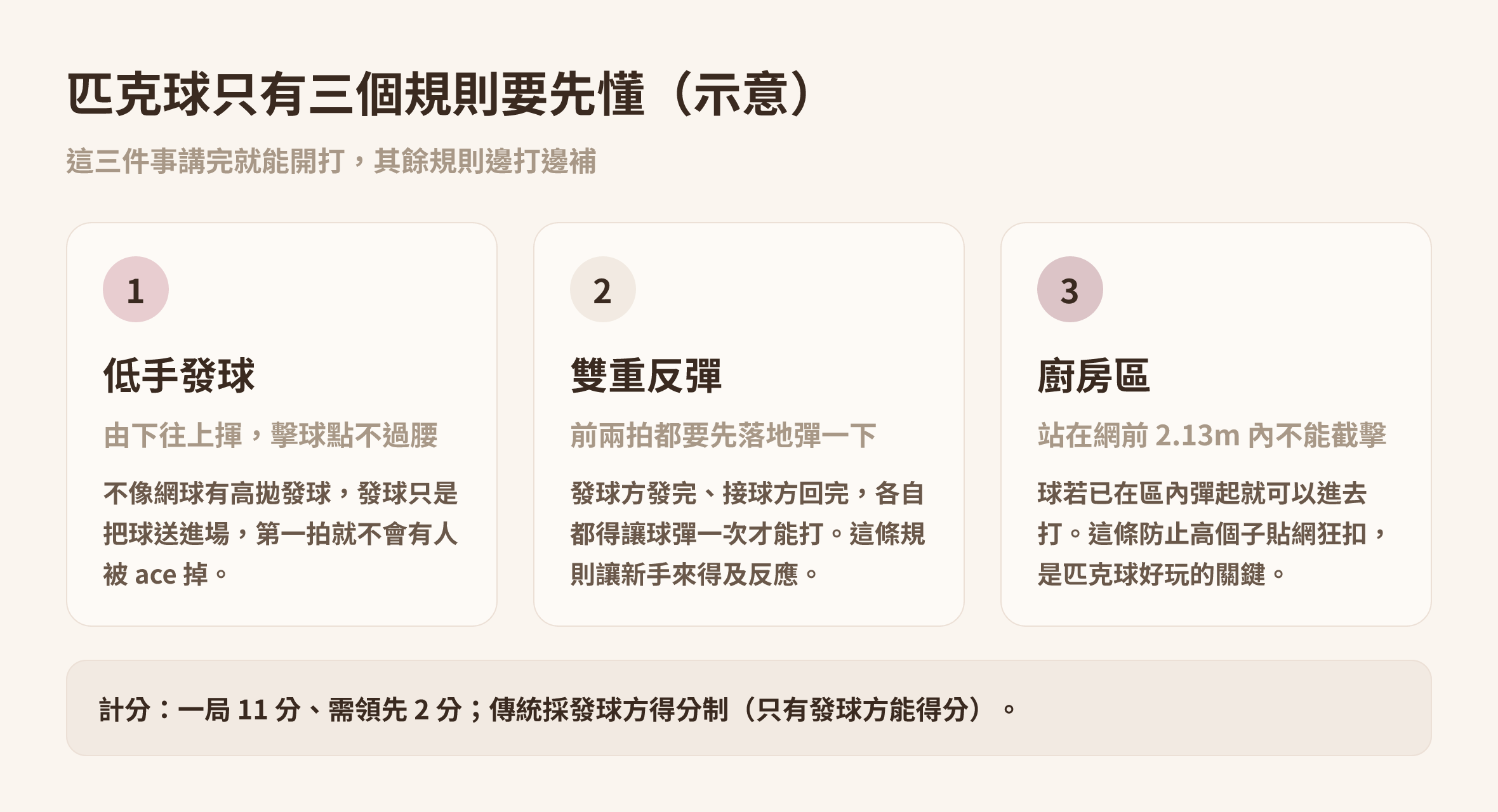
Pickleball has plenty of rules, but beginners only need three of them to start playing. Everything else you can pick up as you go.
1. The Underhand Serve
The serve must be underhand, swung upward, with contact below waist level. That means there are no big overhead serves and nobody gets aced on the first ball. The serve here exists only to put the ball in play — the rally really begins on the third shot.
2. The Double Bounce Rule
This is the one beginners forget: after the serve, the receiving side must let the ball bounce once before returning it, and then the serving side must also let it bounce once. Neither side may volley those first two shots.
The effect is to force the pace down and give both sides time to get into position — exactly why newcomers can keep up immediately.
3. The Kitchen: No Volleying Within 2.13m of the Net
The 2.13-metre (7-foot) strip on each side of the net is the Non-Volley Zone, universally nicknamed the "kitchen."
The rule: you may not volley while standing in the kitchen (hitting the ball before it bounces). If the ball has already bounced inside the kitchen, you're free to step in and play it.
This rule matters enormously — it stops height and power from deciding matches, because nobody can camp at the net and smash everything. The whole reason pickleball rewards soft "dinks" and placement is this one rule.
Scoring
Games go to 11 points, and you must win by 2. Traditional scoring is side-out scoring: only the serving side can score, and the receiving side winning a rally simply takes back the serve.
What Does the Court Look Like? Same Size as a Badminton Court
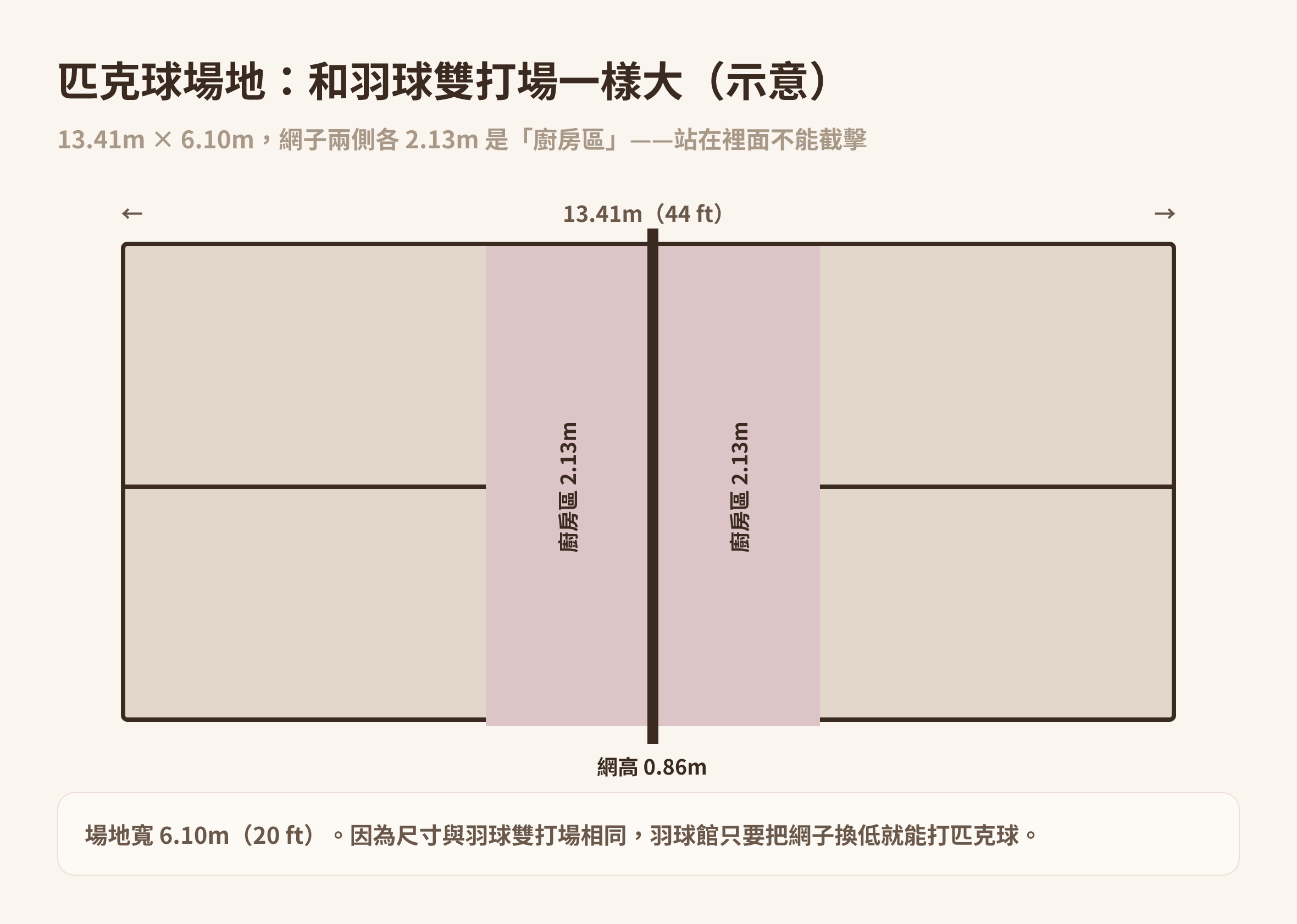
- Court: 13.41m × 6.10m (44 × 20 ft) — identical to a badminton doubles court
- Net: about 0.86m (34 in) at the centre, slightly higher at the posts, and lower than a tennis net
- Kitchen: 2.13m on each side of the net
That "same size as a badminton court" fact is the key one — it means any badminton hall becomes a regulation pickleball court simply by swapping in a lower net. That's how most indoor pickleball in Taiwan currently happens.
Pickleball vs Badminton and Tennis
Badminton is huge in Taiwan, so the most common question is how the two compare.
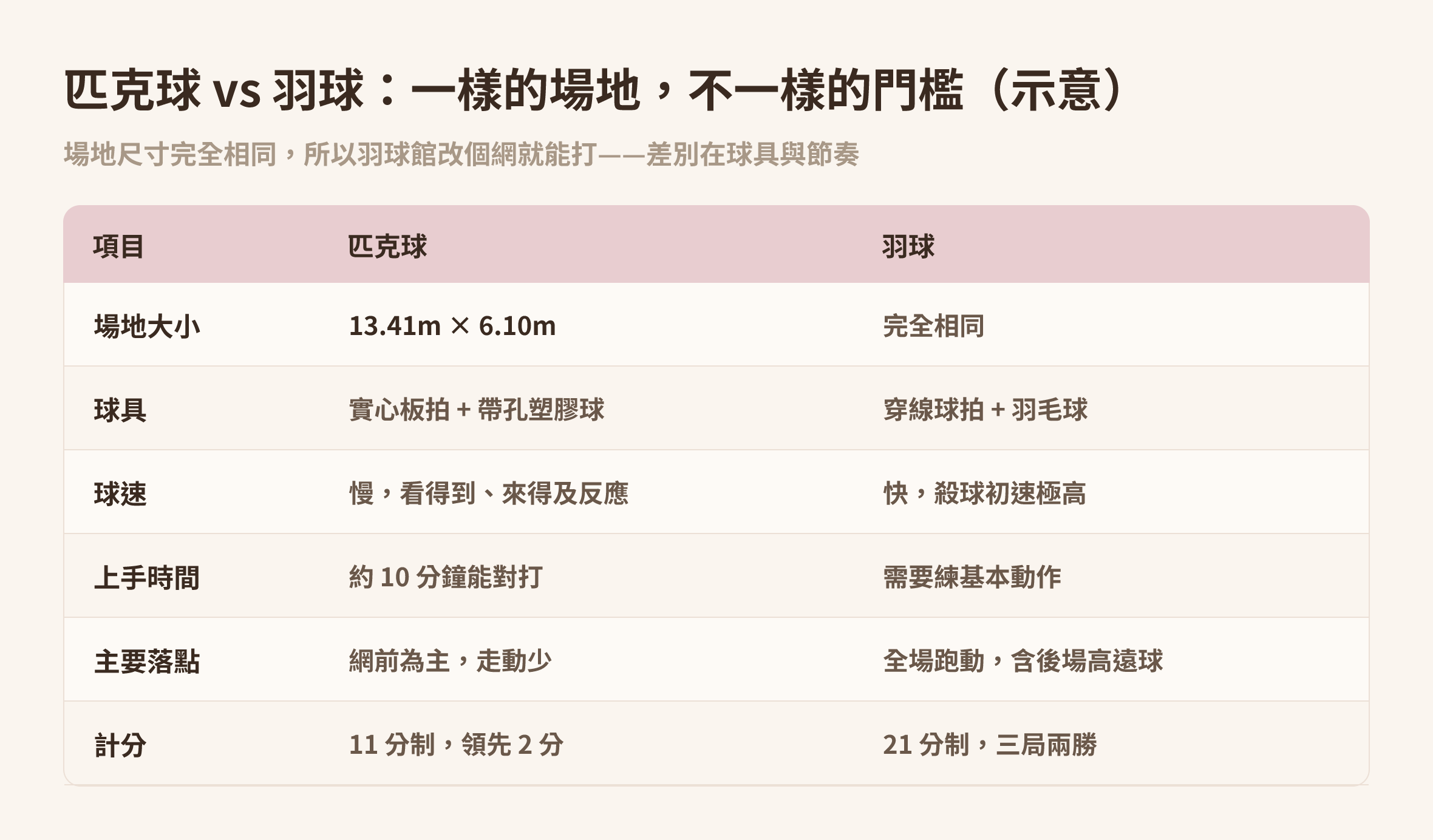
In short:
- vs badminton: same court size, but pickleball uses a solid paddle and a plastic ball. The ball is slow, you don't need wrist power, and there are no deep clears — play concentrates near the net. Badminton rewards technique; in pickleball you can rally on your first attempt.
- vs tennis: a far smaller court, a much slower ball, and an underhand-only serve, so much less load on knees and shoulders. Baseline rallies simply don't exist here.
- vs table tennis: conceptually like a scaled-up version — placement and control matter just as much, except you move your whole body around a court.
Anyone with a badminton or tennis background can usually hold a rally on day one, but playing well means unlearning a few habits — badminton players in particular tend to go for smashes early, and end up either in the net or stepping into the kitchen.
What Gear Do You Need?
The equipment barrier is refreshingly low:
| Gear | Notes |
|---|---|
| Paddle | A solid paddle, larger than a table tennis bat. Beginners should look for a lightweight composite or fibreglass model — easy to control and inexpensive |
| Ball | Hollow perforated plastic, and they differ: indoor balls (fewer, larger holes, lighter) versus outdoor balls (more, smaller holes, harder). Don't mix them up |
| Shoes | Indoor court, badminton or tennis shoes — what matters is lateral support. Avoid running shoes, which are built for forward motion and roll easily on sideways stops |
| Clothing | Ordinary sportswear |
You don't need to buy anything for your first session. Most classes and pickup sessions provide paddles and balls, so play a few times before committing.
Where Can You Play Around Taipei?
Courts in Taiwan fall into three categories, each with trade-offs:
1. Outdoor Park and Riverside Courts (Usually Free)
Taipei and New Taipei now have a number of marked outdoor courts. Most are free with no booking — you turn up and rotate in. The downsides are weather and the fact that outdoor balls feel different from indoor ones.
2. Sports Centre Classes and Open Sessions
District sports centres increasingly run pickleball classes and open play sessions, with coaching and consistent court quality — the best option if you actually want to learn the rules and technique.
3. Badminton Halls with the Net Changed (Indoor, Bookable)
Because the dimensions match, an indoor badminton hall becomes a pickleball court with a lower net. This is how most group and corporate sessions run: indoors, weather-proof, and easy to schedule.
⚠️ Court information changes fast. Pickleball is still expanding in Taiwan, and opening hours, booking requirements and whether equipment is provided change almost every season. Check the venue's or organiser's latest announcement before you go. For rules and competition information, see the Chinese Taipei Pickleball Association.
No One to Play With? That's the Real Barrier
You can learn the rules in ten minutes and look up a court online — but plenty of people stall at the last step: having nobody to play with. Pickleball is mostly doubles, so a court needs four people, and turning up alone is the hardest way to start.
A few options:
- Rotate in at an outdoor park court. Play is usually on rotation, so going alone works — though skill levels vary and it's luck of the draw.
- Community groups. Facebook groups, Threads and Instagram all carry pickup-game posts, best suited to people who already know the rules. Our own pickup schedule lists both badminton and pickleball sessions, and you can sign up on your own.
- Sports centre classes. The most reliable route, and your classmates become your most natural source of playing partners.
- Bring your own group. The fastest and least awkward option — get colleagues or friends together and book the court, gear and coach in one go.
That last option suits groups where nobody has played before: no skill-gap worries, no queuing with strangers, and no need for anyone to know the rules in advance.
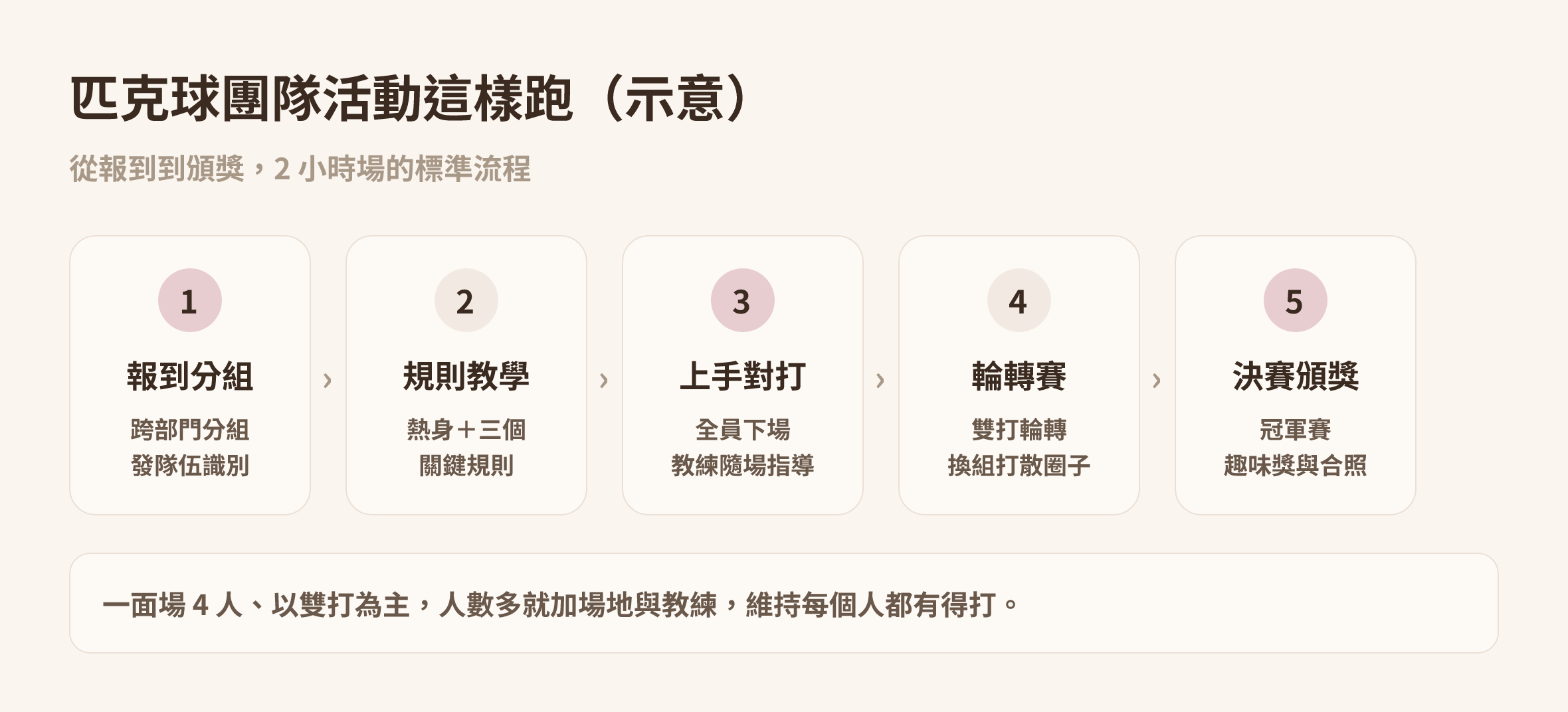
Made Studio's pickleball experience sessions work exactly this way: held at partner indoor or outdoor courts across Taipei and New Taipei, with court and coach included and paddles available to rent on site. The coach covers the warm-up and those three key rules, then everyone plays a rotation. Six people is enough to book, and complete beginners are rallying ten minutes in.
🥒 Pickleball Experience & Team Event Booking → Indoor or outdoor courts in Taipei and New Taipei, from NT$990 per person for a group of 16, paddles available to rent on site. Send us your headcount and date for a tailored quote.
FAQ
Q: Can I play if I'm not remotely athletic? Yes. The court is small, movement is limited and joint impact is low — it was designed for all ages, which is exactly why it's so popular with older players and desk-bound office workers.
Q: How many people per game? Pickleball is mostly doubles, so four per court. Singles exists, but the court and rules favour doubles, which is what almost everyone plays.
Q: Can I ever go into the kitchen? Yes — you just can't volley there. Once the ball has bounced inside the kitchen you're free to step in and play it, then step back out.
Q: How long does it take to learn? About ten minutes to play; there's no ceiling on playing it well. Fast to start and deep to master is precisely why people keep coming back.
Related
- Pickleball Experience & Team Event Booking — bring a group and try it
- Corporate Badminton Booking — same venues, for teams who prefer badminton
- Badminton & Pickleball Pickup Sessions — sign up on your own, get grouped on arrival
- Live Badminton Court Availability, Taipei & New Taipei — if you'd rather find an indoor court yourself