If you want to play badminton in Taipei, the hard part usually isn't the game — it's finding a badminton court that's actually free tonight, and knowing how to book it. This guide explains the main types of badminton courts in Taipei and New Taipei, what they cost, how online booking works, and how to check live court availability in one place — plus what to do if you can't gather enough players to fill a court (short answer: join a pickup session).
Where to play badminton in Taipei? Check live availability first
Taipei and New Taipei have plenty of badminton courts — the tricky part is knowing which venue still has an open slot at the time you want. Instead of opening each venue's website one by one, start here:
🏸 Live badminton court availability in Taipei & New Taipei → One page that pulls together open evening slots (6–10 pm) over the next two weeks across Xinyi Sports Center, NTU Sports Center, Energy Badminton Hall, and the Taipei citizen sports centers — updated every minute. See which venue still has courts, then book directly on that venue's site.
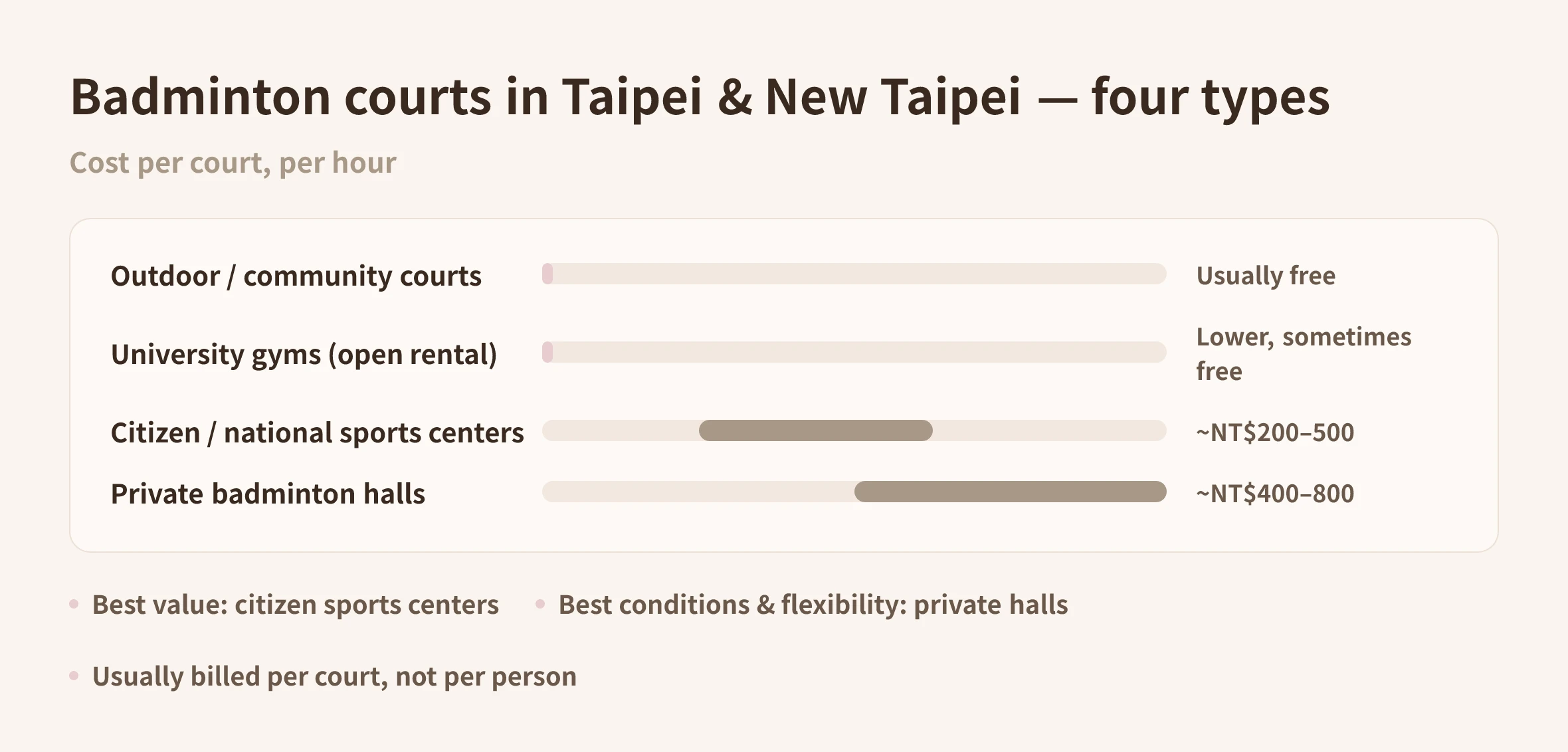
Broadly, courts in Taipei and New Taipei fall into four types:
| Type | Examples | Per court / hour | Notes |
|---|---|---|---|
| Citizen / national sports centers | Xinyi Sports Center, the district citizen sports centers (Zhongzheng, Da'an, Neihu, Shilin, Wenshan, Wanhua, Beitou) | ~NT$200–500 | Most common, modern facilities, online booking — best value |
| University gyms (open rental) | NTU Sports Center (1F multi-purpose / 3F main hall) | Lower, sometimes free | Many courts, good conditions, but limited open hours and hard to grab |
| Private badminton halls | Energy Badminton Hall and similar | ~NT$400–800 | Best conditions, flexible hours, often membership-based |
| Outdoor / community courts | Neighborhood park courts, community centers | Usually free | Free but wind-affected and non-standard — casual play only |
If you're serious about a proper game, most people pick an indoor sports center or private hall — the "indoor vs outdoor" section below explains why.
Renting a badminton court: channels, process, what to check
The four channels above cover almost all badminton court rental in Taipei. Before you book, check these so you don't waste a trip:
- Pricing unit — per court or for the whole hall? Most charge per court.
- Slot length — usually 1-hour blocks; peak times (weekday evenings, weekends) go fast.
- Rackets and shuttles — most venues rent the court only; bring your own gear.
- Splitting the cost — one court fits 4 for doubles, so a full group is what makes it cheap per person.
- When booking opens — many centers don't open same-day slots (earliest is the next day), or only release courts a few days ahead, and popular times sell out the moment they open.
How much do badminton courts cost in Taipei?
Rough badminton court cost in Taipei (per court, per hour):
- Free courts — outdoor park courts and some open school courts: NT$0, but wind-affected, non-standard, and you take your chances on space.
- Citizen / national sports centers — about NT$200–500, the best value and most popular choice.
- Private professional halls — about NT$400–800, best conditions, pick your own time.
Split four ways, a paid court works out to roughly NT$50–200 per person per hour — more affordable than most people expect. The real barrier usually isn't money; it's not being able to fill a court and not knowing which venue is still open. Both are solved below.
How to book a badminton court online
Most badminton court booking in Taipei now runs through online systems. The typical flow:
- Register on the venue's official booking website or app.
- Choose the date, time slot, and number of courts.
- Pay online or on arrival to hold the court.
- Peak slots (weekday 7–10 pm, weekends) often sell out the instant they open, so book a few days ahead.
The annoying part is that you rarely know which venue still has a court tonight without checking each site. That's exactly why we built the live court availability page: it pulls open slots from multiple venues into one place, updated every minute, so you can see what's free first, then book on that venue's official site instead of checking blindly.
Indoor vs outdoor badminton courts
| Indoor court | Outdoor court | |
|---|---|---|
| Wind | None — stable flight | Strong effect — the shuttle is ultra-light and drifts |
| Floor | Sports mat / wooden floor | Concrete, PU track, or park surface |
| Cost | Paid rental, mostly | Usually free (parks, open school courts) |
| Best for | Real practice, matches, drop-in games | Casual play, low budget, basic feel |
The takeaway: if you want to actually practice or play a proper match, choose an indoor court. Outdoor free courts are fine for casual fun if you don't mind the shuttle drifting in the wind.
What a standard badminton court looks like
You only need the basics before renting: under the BWF (Badminton World Federation) standard, a court is 13.4 m long, 6.1 m wide for doubles and 5.18 m for singles, with the net 1.524 m high at the center. Two practical points:
- Ceiling height matters — low-ceiling venues (some community centers) mean high clears hit the ceiling or lights, which is why proper halls are built tall (9 m+ recommended).
- Floor material — proper halls use PVC sports mats or wooden floors that grip and protect your knees, very different from bare concrete.
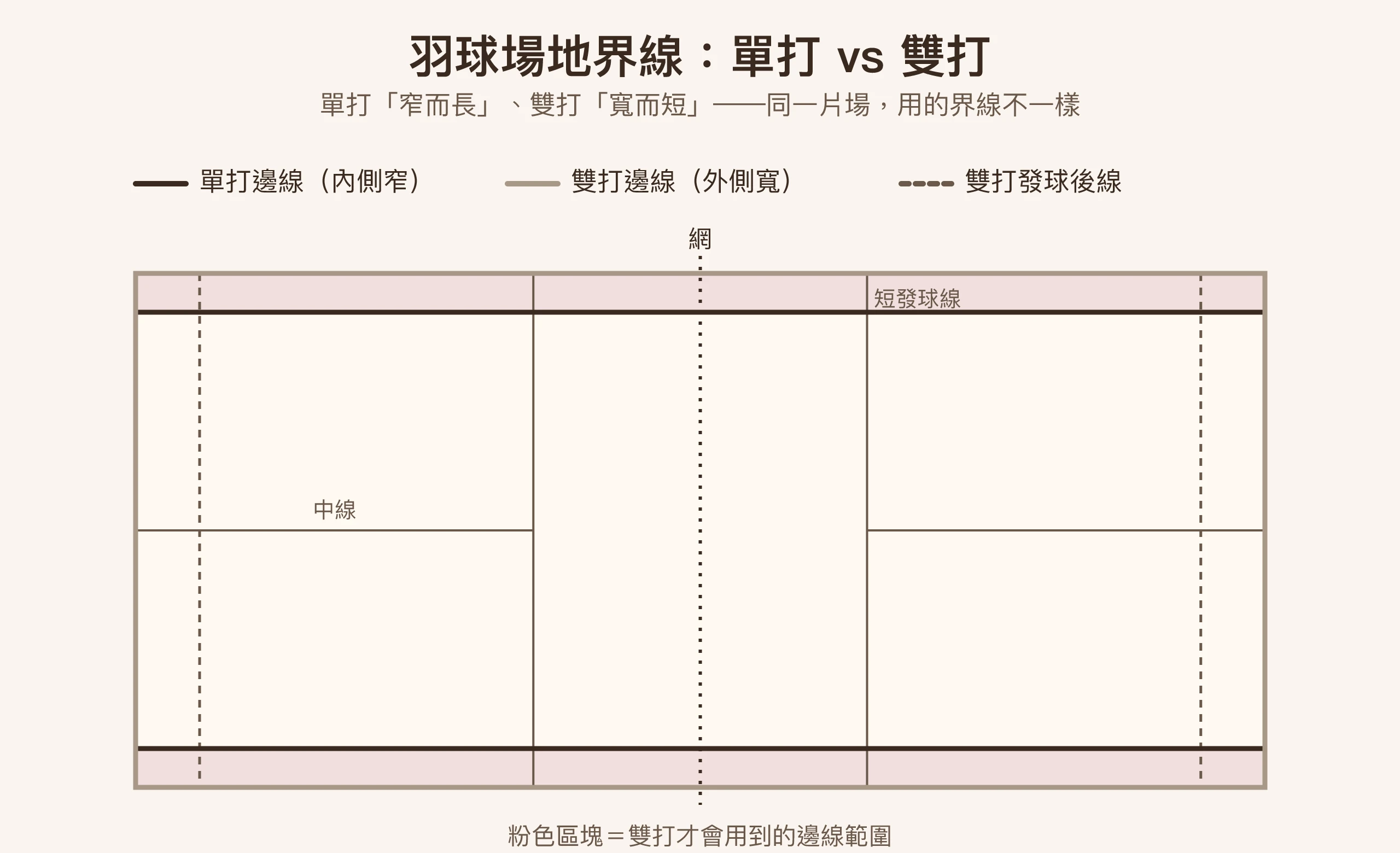
For what the lines mean, why singles and doubles boundaries differ, and how scoring and serving work, see Badminton Rules Explained.
Can't fill a court or find partners? → Join a drop-in game
The real barrier in badminton often isn't the court itself:
- Renting alone isn't worth it — a court needs 4 for doubles to be fun and to split the cost.
- Friends' schedules don't line up — you're finally free but no one else is.
- Beginners hesitate to organize — worried about holding others back.
Drop-in ("pickup") games solve exactly this — no booking, no gathering players yourself. You join a group that's already reserved a court and lined up players, and just show up. A good drop-in group will:
- Reserve a standard indoor court in advance — you only bring yourself.
- Run graded or mixed play so beginners and regulars both get games.
- Split the cost on the spot, usually a couple hundred NT — easier than renting a whole court.
Brand new to the sport? Start with Badminton for Beginners and What Is a Badminton Practice Partner to warm up first.
Badminton courts & drop-in games with Made Studio
Made Studio is in Taipei's East District, a short walk from Zhongxiao Dunhua MRT. Alongside our popular handmade DIY experiences, we run badminton drop-in games, practice-partner sessions, and corporate/group badminton events:
- Drop-in games — we handle the court and the numbers; beginner-friendly, just show up (sign up here).
- Practice partner / coaching — someone to feed and rally with, ideal for getting up to speed.
- Corporate / group badminton — court, coach, and fun games arranged in one place; see How to Run a Corporate Badminton Event and our Team Building page.
Don't want to deal with booking and gathering players? Message us on LINE with your group size, timing, and level, and we'll arrange the court and the game.
Set up a drop-in game on LINE →
FAQ
Where can I check open badminton courts in Taipei?
Use our live court availability page: it pulls open evening slots over the next two weeks from Xinyi Sports Center, NTU Sports Center, Energy Badminton Hall, and the Taipei citizen sports centers into one page, updated every minute — see what's free, then book on that venue's official site.
How much does a badminton court cost in Taipei?
It depends on the venue: citizen/national sports centers run about NT$200–500 per court per hour, private halls about NT$400–800, and school/park courts are cheaper or free. Split among 4 players, that's roughly NT$50–200 per person per hour.
How do I book a badminton court?
Mostly through online systems: register on the venue's official website or app, pick a slot, and pay online or on arrival. Weekday evenings and weekends are peak and often sell out at release, so check the live availability page first, then book on the official site.
What are the standard badminton court dimensions?
13.4 m long; 6.1 m wide for doubles, 5.18 m for singles; net 1.524 m high at the center and 1.55 m at the posts. These are the BWF standard, consistent across proper halls — see Badminton Rules for line and scoring detail.
Indoor vs outdoor — which should I choose?
The biggest difference is wind. The shuttle is extremely light, so outdoors it drifts and normal rallies are hard; indoor courts have no wind, proper flooring, and stable flight — always choose indoor for a serious game.
Can I play badminton on my own?
Not easily — a court needs about 4 players for doubles to be fun and cost-effective. The simplest option is to join a drop-in game: no booking or gathering players, just show up, and beginners are welcome.
Related reading
- Pickup sessions: the schedule you can join on your own
- Live badminton court availability in Taipei & New Taipei
- Badminton Rules Explained: scoring, serving, singles vs doubles
- Badminton for Beginners: what to know for your first game
- What Is a Badminton Practice Partner? Finding one, costs, who it's for
- How to Run a Corporate Badminton Event: flow, cost, fun games
- Corporate & Team Building page