For most people picking up a racket for the first time, the tricky part isn't the swing — it's the badminton rules. How many points wins? Can you really not serve above the waist? Why are the singles and doubles lines different? The good news: badminton rules are simpler than they look. Get your head around three things — scoring, serving and the court lines — and you can comfortably play a full match.
This guide breaks down the rules that trip up beginners most, in the plainest way possible. And at the end, we'll show you that not knowing the rules yet is totally fine — how to find a hitting partner and run a group badminton session everyone can enjoy. Honestly, the fastest way to learn the rules is to play — you can join a pickup session on your own and get grouped up on arrival.
How do you win a game of badminton? (21-point scoring)
Modern badminton uses 21-point rally scoring: whoever wins the rally scores 1 point, regardless of who served — unlike the older system where only the serving side could score.
- Best of three games: the first side to win two games wins the match.
- 21 points per game, and you must lead by 2 points to win the game.
- Deuce: if the score reaches 20–20, play continues until one side leads by 2 (e.g. 24–22).
- Capped at 30: if it's a marathon to 29–29, the first side to reach 30 wins outright — no 2-point lead required.
In other words, a game ends at a minimum of 21 points and a maximum of 30. The side that just scored serves next, which is why the serve keeps switching between players.
Badminton serve rules (where most people go wrong)
The serve is the most disputed part of the badminton rules. Remember these points and you won't fault:
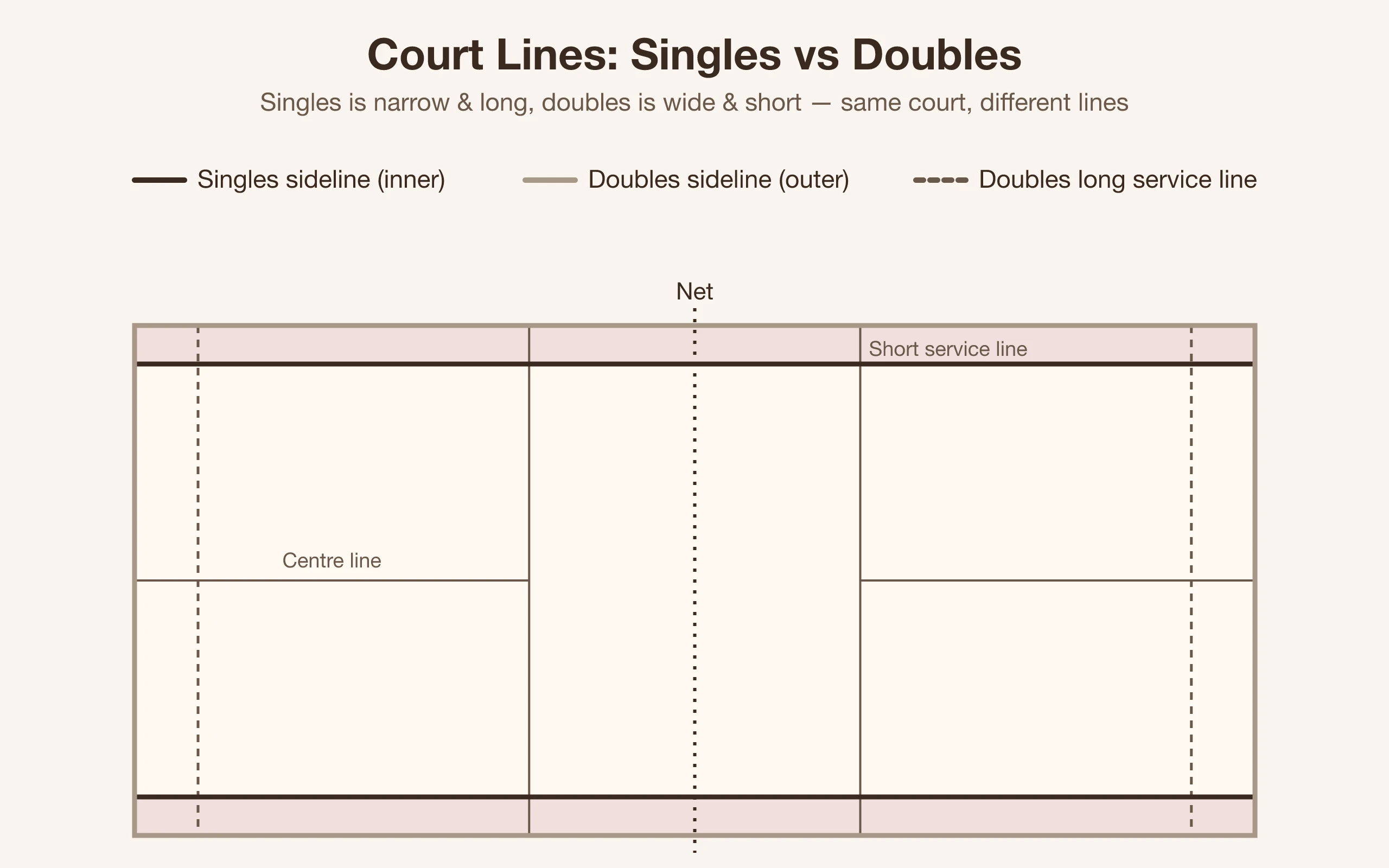
- Serve diagonally: the serve must land in the diagonally opposite service court — you can't serve straight ahead.
- Height limit: at the moment of contact, the whole shuttle must be below the server's waist (roughly the bottom of the ribcage), with the racket head clearly pointing down — no overhand serves.
- Feet stay grounded: part of both feet must stay in contact with the floor during the serve — no stepping or walking.
- Right for even, left for odd: the serving side serves from the right service court when their score is even (including 0), and the left when it's odd. Memorise this and you'll never stand on the wrong side.
Quick note: the newer rules use a fixed 1.15-metre serve height as the professional standard, but for casual and group play the "below the waist" guideline is fine — no need to overthink it.
Singles vs doubles: how do the lines differ?
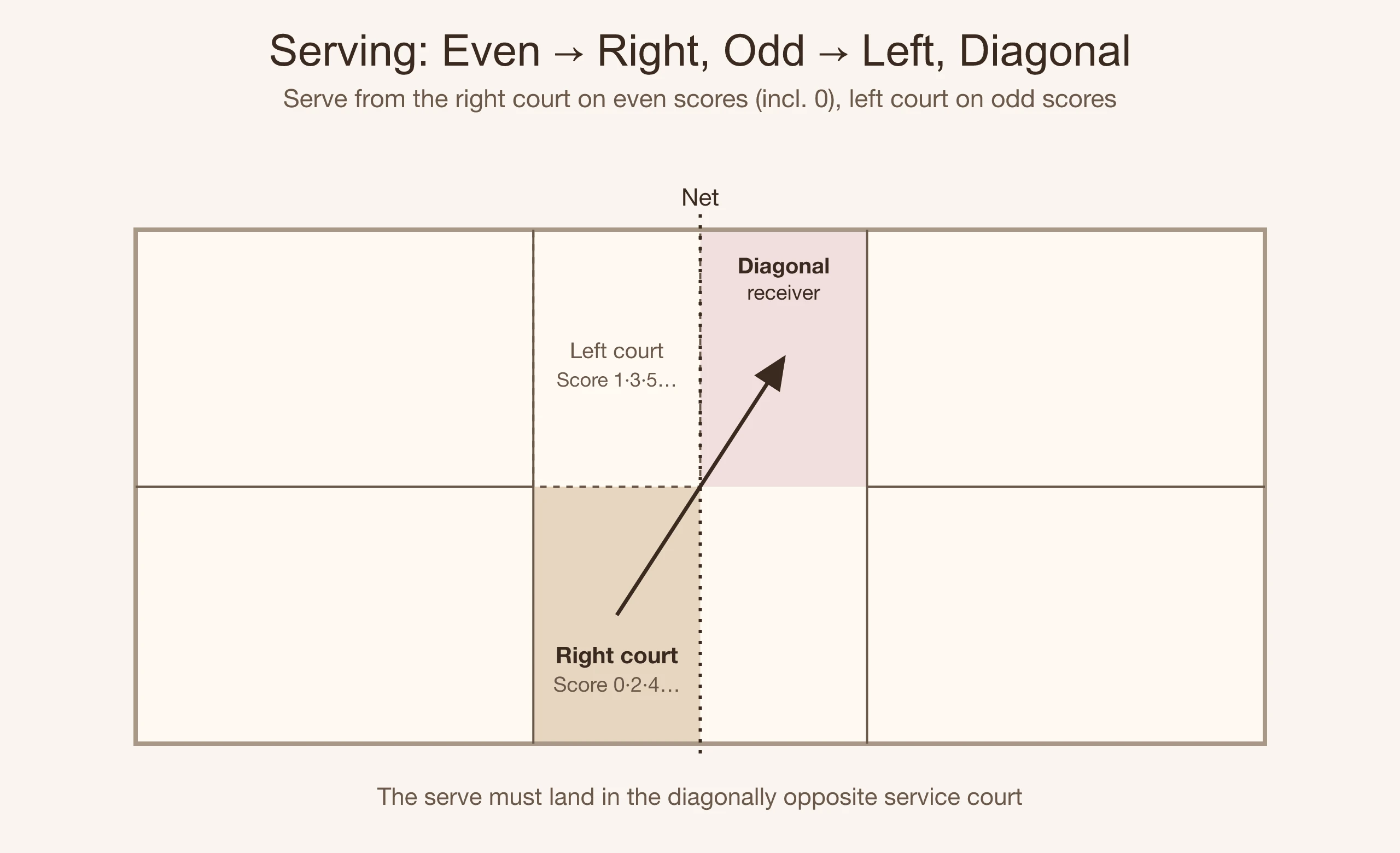
On the same court, singles and doubles use different boundary lines — this is what beginners mix up most:
| Singles | Doubles | |
|---|---|---|
| Side lines | Use the inner (narrow) side lines | Use the outer (wide) side lines |
| Serve back line | Use the outer (long) back line | Use the inner (short) back line (when serving) |
| Rally back line | Outermost long back line | Outermost long back line |
One-line memory trick: singles is "narrow and long", the doubles serve is "wide and short". That is, the doubles court is wider side to side but you can't serve too deep; the singles court is narrower but you can serve all the way to the back.
In or out — how is it judged?
- On the line is in: if the shuttle touches the line at all, it's in.
- Look at where it lands, not where it crosses: in or out is judged by where the shuttle lands, not where it was when it flew over the net.
- Serve clipping the net: under current rules, if the serve clips the net and still lands in the correct service court, it counts — just play on.
Common badminton faults (points you'll lose)
Beyond serving faults, these actions also lose the point outright:
- Touching the net: your racket, body or clothing touches the net while the shuttle is in play.
- Hitting over the net: striking the shuttle in the opponent's court (a follow-through that carries over is fine).
- Double hit: the same side contacts the shuttle twice in a row.
- Shuttle hits your body: the shuttle strikes your body or clothing.
- Carrying (slinging): the shuttle rests on or is "carried" by the strings rather than being hit cleanly.
Still fuzzy on the rules? A hitting partner is the fastest fix
You can read all the rules you like, but a few real games will cement them faster. Beginners usually get stuck with "no one to play with, and no one to correct their form". This is where hiring a coach as a hitting partner or taking a badminton lesson speeds you up the most — someone to feed you shuttles and point out your faults beats flailing away on your own.
If you just want to get on court, there are really only two things to solve: a court and people to play with. Open slots around Taipei and New Taipei are scattered across seven or eight separate booking systems, so live court availability for Taipei & New Taipei pulls them into one page; and if you'd rather not round up three other players yourself, you can join a pickup session — sign up alone and you'll be grouped on arrival.
If your company or club wants to get moving together, you can also run a group badminton session: coach-led hitting practice, basic lessons and fun games can all be arranged, so colleagues who can't play still take part. Made Studio arranges badminton hitting partners, lessons and fun games for companies and groups — see Corporate & Team Building activities.
Frequently Asked Questions
How many points wins a game of badminton?
The current format is 21-point rally scoring, best of three games. A game is won by reaching 21 points with at least a 2-point lead; at 20–20 it goes to deuce and you play until one side leads by 2, capped at 30 (after 29–29, the first to 30 wins).
Can you serve above the waist in badminton?
No. At the moment of contact, the whole shuttle must be below the server's waist with the racket head pointing down — it must be an underhand serve. A serve above the waist is called a fault and loses the point.
How do the singles and doubles lines differ in badminton?
Singles uses the inner (narrow) side lines and the outer (long) back line — narrow and long. Doubles uses the outer (wide) side lines, but the serve must land inside the inner short service line — wide and short. During rallies both sides use the outermost long back line.
Do you serve from the left or the right in badminton?
It depends on the serving side's score: serve from the right service court when the score is even (including 0), and from the left when it's odd, always diagonally.
Is a shuttle on the line in or out in badminton?
It's in. If the shuttle's landing point touches the line at all, it counts as in — the call is based on where the shuttle lands, not where it was when it crossed the net.
Want to actually play a match?
Reading rules only goes so far — nothing beats booking a real session. Whether you want a hitting partner, a badminton lesson, or to run fun badminton games for your company or club, tell us your headcount and needs on LINE and we'll handle the arrangements and a quote.
Enquire on LINE about badminton hitting partners, lessons & group activities →
Related reading
- Badminton Courts in Taipei & New Taipei: Where to Play, How to Book & Live Availability
- Live court availability, Taipei & New Taipei
- Pickup sessions: the schedule you can join on your own
- Badminton for Beginners: Grip, Serve, Footwork & Gear in One Guide
- What Is a Badminton Hitting Partner? Coaches, Cost & Who It's For
- Fun Badminton Game Ideas: How to Run a Corporate Badminton Team-Building Event
- Corporate Badminton Team-Building Guide: Cost, Headcount, Venue & Flow
- Corporate badminton booking & quote page
- Corporate & Team Building Activities